A
Asianometry·TechThe Little Vertical Laser That Everyone Uses
TL;DR
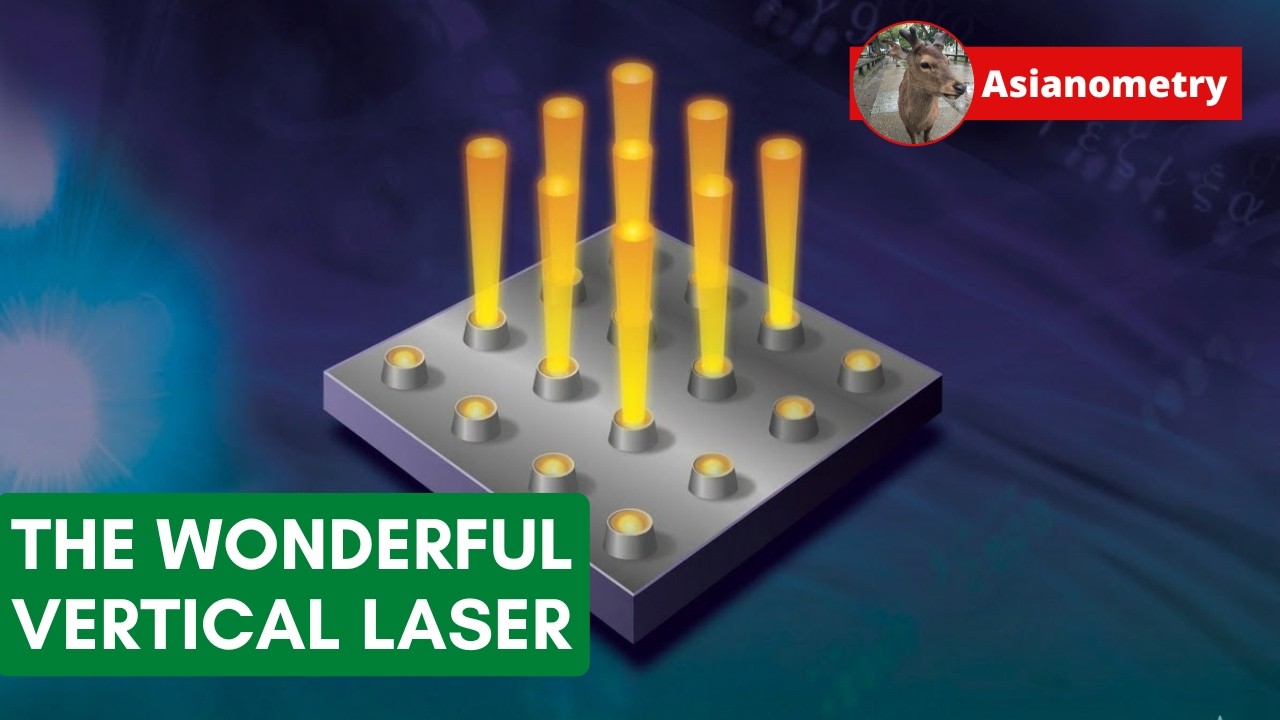
VCSELs — vertical lasers firing from a wafer's surface — were invented by Kenichi Iga in 1977 and now power fiber networks, optical mice, Face ID, and LiDAR.
Key Points
- 1.Kenichi Iga conceived the VCSEL in a midnight dream on March 22, 1977. Frustrated by the manual, unreliable cleaving process used to make edge-emitting lasers, he sketched a vertical-firing laser that could be manufactured monolithically in a fab — no surgical knives required.
- 2.The VCSEL fires light vertically from a wafer's surface, not its edge. This yields a circular beam (easier to focus), enables testing of up to one million lasers per wafer before dicing, and allows monolithic semiconductor fabrication — solving the scalability problem of traditional edge-emitting lasers.
- 3.Early VCSELs were impractical: the first 1979 prototype only worked at 77 Kelvin. The core problem was a high threshold current caused by leaky optical cavities; the fix required mirrors with 99%+ reflectivity, achieved using quantum wells and Bragg Reflectors — demonstrated at room temperature by 1988–1989 by both Iga and a Bell Labs team led by Jack Jewell.
- 4.Gigabit Ethernet was the commercial breakthrough that launched mass VCSEL production. LEDs were too slow and edge-emitting lasers too unreliable for the standard; VCSELs' low cost, round beam, and easy fiber coupling made them the winner. Honeywell brought them to market in volume in 1996, followed by Motorola and Agilent.
- 5.The post-dot-com bust pushed VCSELs into optical mice, reaching over one billion units made. Agilent integrated VCSELs into 'engine modules' in 2004; their coherent beam outperforms LEDs on difficult surfaces like metal and glass, securing VCSELs in the high-end mouse segment.
- 6.Face ID on Apple's iPhone X (November 2017) made 3D sensing the biggest VCSEL market. Using structured light to project and read a dot pattern, VCSEL arrays now anchor facial recognition in smartphones; automotive LiDAR for EVs and self-driving cars is the next major growth frontier, though lower efficiency and brightness remain ongoing challenges.
Continue yapping less
 46:26
46:26Asianometry
General Motors' Robot Debacle
 26:18
26:18Asianometry
Sweden Made DC Great Again
 1:28:24
Asianometry
An Interview with Josh Fisher | Inventing VLIW, Multiflow, Itanium, VLIW's Massive Success
 1:11:19
Asianometry
An Interview with Josh Fisher | Inventing VLIW, Multiflow, Itanium, VLIW's Massive Success
 21:32
21:32AI Explained
Two Rival Bets on AGI: Google I/O Highlights
 32:37
32:37NetworkChuck
I'm switching to Hermes (goodbye OpenClaw!!)
 17:21
17:21Mrwhosetheboss
I Investigated IKEA's Ridiculously Cheap Tech
 17:59
17:59Linus Tech Tips
Google's Most-Hated Announcement Ever
Life's too short for long videos.
Summarize any YouTube video in seconds.
Quit Yapping — Try it Free →