
S
SciShow·History & Geopolitics6 Things Ancient Coins Taught Us
TL;DR
Ancient coins reveal economic crises, trade routes, political propaganda, religious values, and site dating with more precision than carbon dating.
Key Points
- 1.Coins turning into jewelry signals economic collapse. About 60% of Roman coins found outside Kent from the Anglo-Saxon period were pierced or altered, indicating Romans' departure made coins worthless so locals repurposed them as decoration.
- 2.Deliberate coin debasement reveals fiscal crises. By 87 BCE, Rome was secretly adding 5–10% copper to silver denarii during wartime debt — an ancient form of inflation that mirrors modern monetary policy.
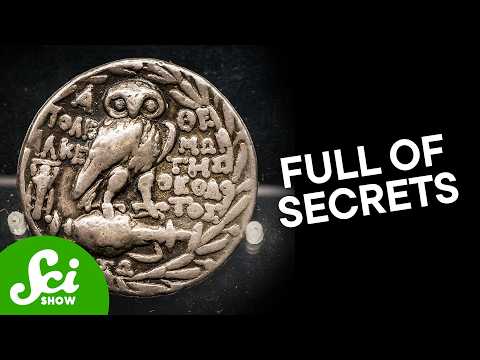
- 3.Metal composition exposes ancient trade networks. Lead, zinc, and gold trace-element analysis of early Athenian silver tetradrachms shows the metal came from Spain, France, Romania, and Turkey — not nearby Greek mines as assumed.
- 4.Julius Caesar's coin was the first living Roman's face on currency. Minting 'Dictator for Life' on a coin in 44 BCE was a political power play; he was assassinated days after, setting the precedent for emperors stamping their faces on coins.
- 5.Coins date archaeological sites more precisely than carbon dating. A French coin bearing Louis XIV's face, minted 1632–1634, pinpointed an Inuit site in Quebec to the 1630s — a timeframe too recent for carbon dating to resolve accurately.
- 6.In 696 CE, Caliph Abd al-Malik introduced text-only Islamic coins to distinguish his empire from Byzantine Christian imagery. The calligraphy-only design flexed Arabic as a unifying literate language, while still declaring him 'God's Deputy.'
Life's too short for long videos.
Summarize any YouTube video in seconds.
Quit Yapping — Try it Free →