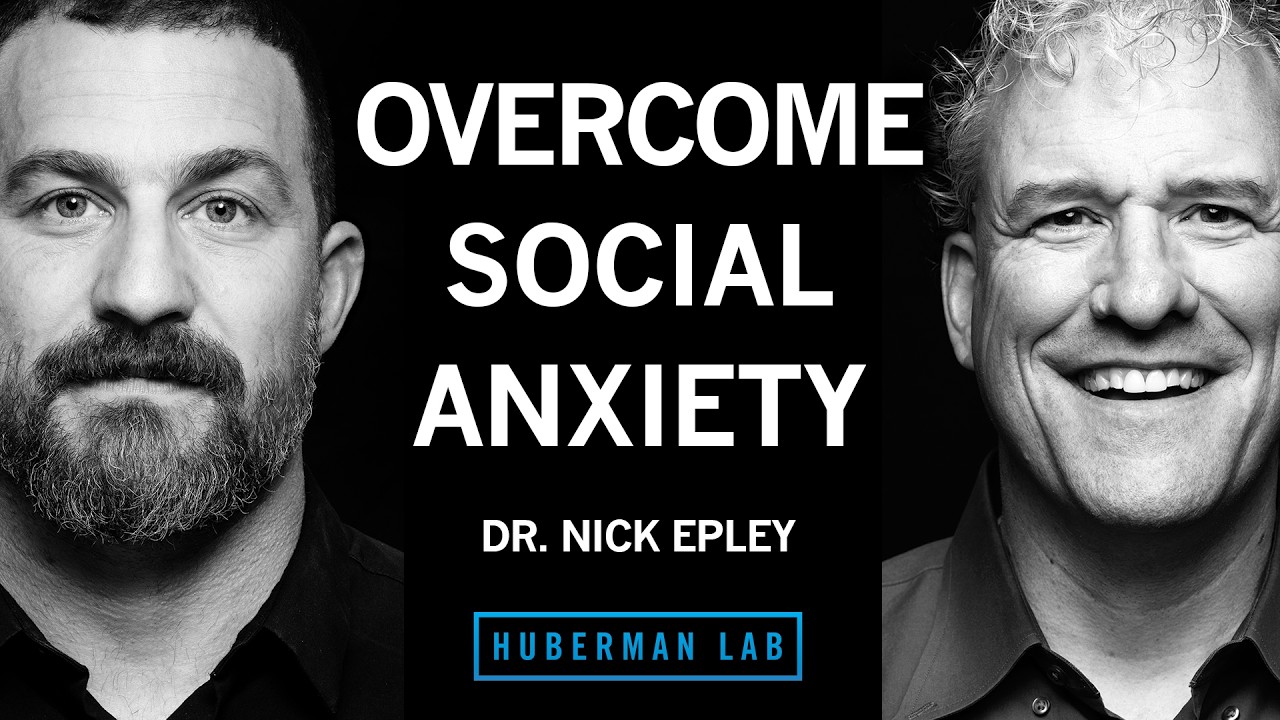
How to Overcome Social Anxiety | Dr. Nick Epley
TL;DR
Expose yourself to real social situations rather than simulations, because social anxiety stems from mistaken beliefs about rejection that direct experience corrects.
Key Points
- 1.Real exposure — not simulation — cures social anxiety. Pretend speeches and role-play don't work because they're still fake; only genuine interactions with strangers correct the mistaken belief that you'll be rejected.
- 2.Social anxiety is built on wildly misplaced beliefs. People consistently overestimate how often others will reject them; direct experience reveals acceptance is far more common than feared.
- 3.Anthropomorphism is the brain's tool for predicting independent agents. We infer minds — thoughts, beliefs, intentions — behind anything that moves independently, from other humans to animals to gods, because it helps us predict behavior.
- 4.Three mechanisms drive social judgment, each with built-in errors. Egocentrism causes us to assume others think like us; stereotyping exaggerates group differences; and the correspondence bias leads us to infer simple, direct intentions from behavior.
- 5.Humans uniquely dominate social IQ, not physical reasoning. A Max Planck Institute study of 100+ toddlers, 100+ chimps, and 36 orangutans found all three groups performed equally on physical problem-solving, but two-year-olds crushed the competition on social tasks like gaze-tracking and intention-reading.
- 6.Eye gaze is the richest real-time signal of another mind. Humans can detect whether someone is looking at them versus a few degrees off from 50 feet away, and this sensitivity evolved because tracking gaze reveals what another person is thinking about.
- 7.Voice conveys the presence of a mind, not just information. Pitch variation, pace, and deliberation signal enthusiasm, emotion, and active thinking — cues entirely absent from typed text, which Epley calls 'dead text.'
- 8.Hearing someone speak dramatically reduces dehumanization of political opponents. In a 2016 election study with Juliana Schroeder, Trump and Clinton voters rated the other side as more intelligent, thoughtful, and rational after hearing their voice versus reading their written pitch.
- 9.MBA students systematically underestimate the power of voice. When given a choice, most prefer to write to seem intelligent, unaware that recruiters — including Fortune 500 professionals — rate spoken pitches as significantly more intelligent and hirable.
- 10.The '80% nonverbal' communication statistic is pop psychology myth. Words clearly carry essential content; paralinguistic cues matter above and beyond words but cannot replace them — Epley calls the 80% figure a 'highly stylized experimental result.'
- 11.Going from zero social contact to any contact is the biggest well-being leap. A Kahneman and Deaton Gallup daily well-being study found that spending a day entirely alone versus with others produced a well-being difference roughly seven times larger than a $60,000 income difference.
- 12.Loneliness triggers cortisol spikes that damage cardiovascular and immune health. Research by the late University of Chicago psychologist John Cacioppo showed the brain's neural architecture is wired to signal distress during isolation to force social reconnection.
- 13.Texting maintains relationships but doesn't build them. Brief contact like a heart emoji can sustain an established bond, but half an hour of typing is an inferior substitute for a phone call when it comes to developing a meaningful new relationship.
- 14.Our sense of self is constructed through social interaction — the 'looking glass self.' Early 20th-century sociologist theory, supported by solitary confinement research, shows prolonged isolation erodes self-concept and self-worth, because self-esteem functions as a monitor of how well we're connecting with others.
- 15.Online trolling may be driven by social isolation, not malice. Epley suggests people in basements posting extreme comments are likely motivated by the deep human need to see their thoughts have visible impact on others — a distorted form of the universal need for social reverberation.
Continue yapping less
 33:16
33:16Huberman Lab
Understanding & Controlling Aggression | Huberman Lab Essentials
 2:27:43
Huberman Lab
Master Self Control & Overcome Procrastination | Dr. Kentaro Fujita
 33:37
33:37Huberman Lab
Essentials: Compulsive Behaviors & Deep Brain Stimulation | Dr. Casey Halpern
 2:09:56
Huberman Lab
Tools to Bolster Your Mental Health & Confidence | Dr. Paul Conti
 5:33
5:33SciShow
How Onions ACTUALLY Make You Cry (And How to Stop Them)
 12:25
12:25Hank Green
I Just Want to Fix Things
 14:21
14:21SciShow
Can We Describe The Whole Universe With A Single Number?
 7:04
7:04Sabine Hossenfelder
Biologists Say They Cracked One of Life's Biggest Mysteries
Life's too short for long videos.
Summarize any YouTube video in seconds.
Quit Yapping — Try it Free →