
T
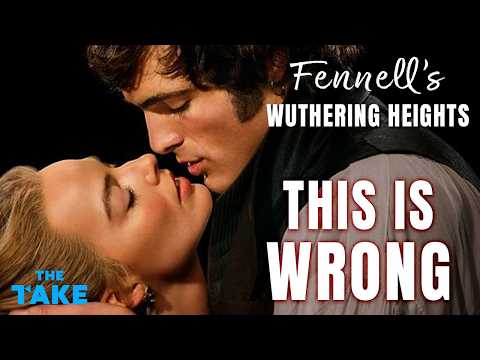
The Take·EntertainmentThe Gothic Novel Becomes a Barbie Dream | Fennell's Adaptation Problem
TL;DR
Emerald Fennell's Wuthering Heights adaptation transforms Brontë's ferocious Gothic novel into a Barbie fantasy by erasing Heathcliff's race, Isabella's abuse, and the redemptive second generation.
Key Points
- 1.Fennell consciously built her adaptation around teenage feeling, not the source text. She admitted she couldn't encompass the novel's greatness, so she recreated how it made her feel as a teenager — producing, consciously or not, a Barbie/Ken framework for Kathy and Heathcliff.
- 2.Every visual choice codes Kathy as a Barbie doll, not a person. Margot Robbie, 35 and culturally synonymous with Barbie, is dressed in iridescent collector-edition costumes, given 'doll braids,' placed in a mood-board dreamhouse, and physically reduced in scale throughout the film.
- 3.Casting a white Heathcliff erases the racial wound that is the novel's structural engine. Brontë explicitly describes Heathcliff as dark-skinned, a Liverpool foundling during the slave-trade era; his otherness drives every humiliation and obsession. Fennell cast white Australian Jacob Elordi because he matched her '90s paperback cover fantasy.
- 4.The skin-wallpaper scene exposes the film's unexamined racial logic. Edgar — played by an actor of Pakistani descent — praises the whiteness of Kathy's skin printed on his bedroom walls, literalising Barbie's racial default without the film registering the full implications.
- 5.Rewriting Isabella as a willing sadomasochist defangs Heathcliff and misrepresents abuse. Brontë's Isabella is a naive victim who escapes and survives, signalling the cycle can be broken; Fennell's Isabella barks like a dog by choice, turning tragedy into titillation and echoing the 'rough sex defence' used to minimise domestic violence.
- 6.Giving Kathy and Heathcliff explicit sex removes the novel's core horror. Brontë's electricity comes from desire blocked by class, marriage, and obsession — relief is what the story cannot survive. Fennell's sex scenes sanitise rather than confront, leaving Heathcliff a brooding pinup reciting famous lines like a talking Ken doll.
- 7.Cutting the second generation amputates the novel's entire moral argument. Brontë's story ends a generation later when Kathy's daughter and Heathcliff's nephew break the toxic cycle; Fennell removes the daughter entirely, strips Kathy of agency over her own death, and leaves only darkness without exit — glamorised nihilism sold to audiences who may never read the book.
Life's too short for long videos.
Summarize any YouTube video in seconds.
Quit Yapping — Try it Free →