
S
Slidebean·TechYour TV Is Ruining Every Movie You Watch
TL;DR
Your TV's 60Hz refresh rate is incompatible with film's 24fps standard, forcing either stuttery jitter or artificial frame-smoothing that destroys directors' intended aesthetics.
Key Points
- 1.The core problem is a 24fps vs 60Hz mismatch. Movies have been shot at 24 frames per second for nearly 100 years, but most TVs refresh at 60Hz — these two numbers don't divide evenly, causing unavoidable conversion artifacts.
- 2.The 3:2 pulldown creates visible jitter. To fit 24fps into 60Hz, TVs hold some frames for 2 cycles and others for 3, causing a stutter or judder especially visible in panning shots — a well-documented problem with no clean fix at 60Hz.
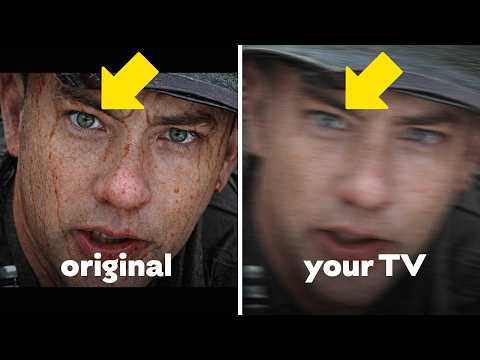
- 3.The smoothing 'fix' is arguably worse. Most TVs generate artificial in-between frames to eliminate jitter, producing the 'soap opera effect' — a hyper-smooth look completely foreign to what filmmakers intended and despised by cinephiles.
- 4.Film's 24fps standard was partly accidental. Hollywood standardized 24fps in the late 1920s because it synced audio, made 1 minute equal ~90 feet of film in imperial units, and minimized expensive film usage — not for purely aesthetic reasons.
- 5.TV's 60Hz came from the power grid, not film. North American TVs were tied to the 60Hz AC electrical grid frequency to avoid humming and interference, while European TVs ran at 50Hz — two incompatible standards that persist to this day.
- 6.Saving Private Ryan used a 45° shutter angle deliberately. Cinematographer Janusz Kamiński used a 45° shutter instead of the standard 180°, exposing each frame for ~1/200th of a second instead of 1/48th, eliminating motion blur and creating the iconic frozen, chaotic battle aesthetic.
- 7.120Hz TVs mathematically solve the problem. Since 120 is divisible by both 24 and 30, a 120Hz TV can display each film frame for exactly 5 cycles with no uneven pulldown — eliminating jitter for movies, TV shows, and broadcasts simultaneously.
- 8.Variable refresh rate (VRR) is another solution. Newer TVs and devices like Apple TV support VRR, allowing the screen to dynamically switch to 24Hz when playing film content — but requires a compatible TV, VRR-enabled HDMI cable, and proper settings activation.
Life's too short for long videos.
Summarize any YouTube video in seconds.
Quit Yapping — Try it Free →