
M
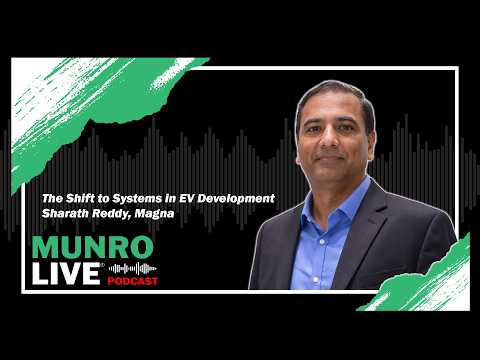
Munro Live·Car Reviews & AutomotiveThe Shift to Systems in EV Development | Sharath Reddy, Magna - Munro Live Podcast
TL;DR
Magna SVP Sharath Reddy explains why cross-domain systems thinking is essential as automotive electrification, HPC, and software-defined vehicles replace siloed component engineering.
Key Points
- 1.Traditional OEMs still operate in silos, slowing EV development. Vehicles still average 150 ECUs, development cycles run 36–48 months, and organizational silos prevent cross-domain collaboration that newer OEMs achieve in as little as 18 months.
- 2.Magna supports customers across the full HPC spectrum. From build-to-print ECUs to complete sensor-hardware-software systems, Magna works with multiple SOC partners so customers can choose their own architecture or sensors like cameras and radar.
- 3.Thermal management is a hidden cost driver in centralized compute. Moving from passive to active liquid cooling for HPC ECUs adds significant cost and maintenance complexity, requiring Magna to leverage powertrain thermal expertise to offer scalable solutions.
- 4.Sensor fusion remains Magna's recommended approach over single-modality systems. Cameras struggle in tunnels and rain, radar costs have fallen dramatically since the early 2000s, and AI-based fusion has significantly reduced false positives in production systems.
- 5.LiDAR is still expensive but mainly needed for Level 3–4 autonomy. For L2/L2+ ADAS, radar and camera fusion suffices; Magna also fuses thermal cameras as a lower-cost LiDAR alternative for higher-level autonomy applications.
- 6.Magna's interior sensing portfolio includes a PACE Award-winning DMS camera integrated behind the rearview mirror glass. A 5-megapixel camera with auto-calibration covers both driver and passenger, is in production in Europe, and interior radar detects child heartbeats in rear rows.
- 7.Only 30% of vehicles sold in 2030 will have SDV-level architecture. Barriers include massive infrastructure investment, cybersecurity requirements, organizational inertia, and the need for 15-year backward/forward software compatibility versus a 3-year smartphone replacement cycle.
- 8.Chinese OEMs gained competitive advantage by embracing iterative, faster development cycles. They adopted Tesla-era technologies sooner, focus on consumer-facing features, and launch new vehicle generations in ~2 years while traditional OEMs are still launching generation one.
- 9.Magna pursues cost reduction through innovation like single-piece battery trays and shared door latches across 10 customers in China. Design-for-automation is now a core initiative alongside simultaneous engineering, aiming to lower BOM costs and improve quality without compromising reliability.
Life's too short for long videos.
Summarize any YouTube video in seconds.
Quit Yapping — Try it Free →